Parametric survival models for a signature's risk score
Source:R/survival_parametric.R
survival_parametric.Rdsurvival_parametric() scores each sample of a
SummarizedExperiment with the signature's joint Cox coefficients and
fits a set of parametric accelerated-failure-time models of the event time
on that score, using survreg. It returns an AIC
comparison across the fitted distributions, the fitted survival curves
(evaluated at the mean risk score) for overlay on the Kaplan-Meier
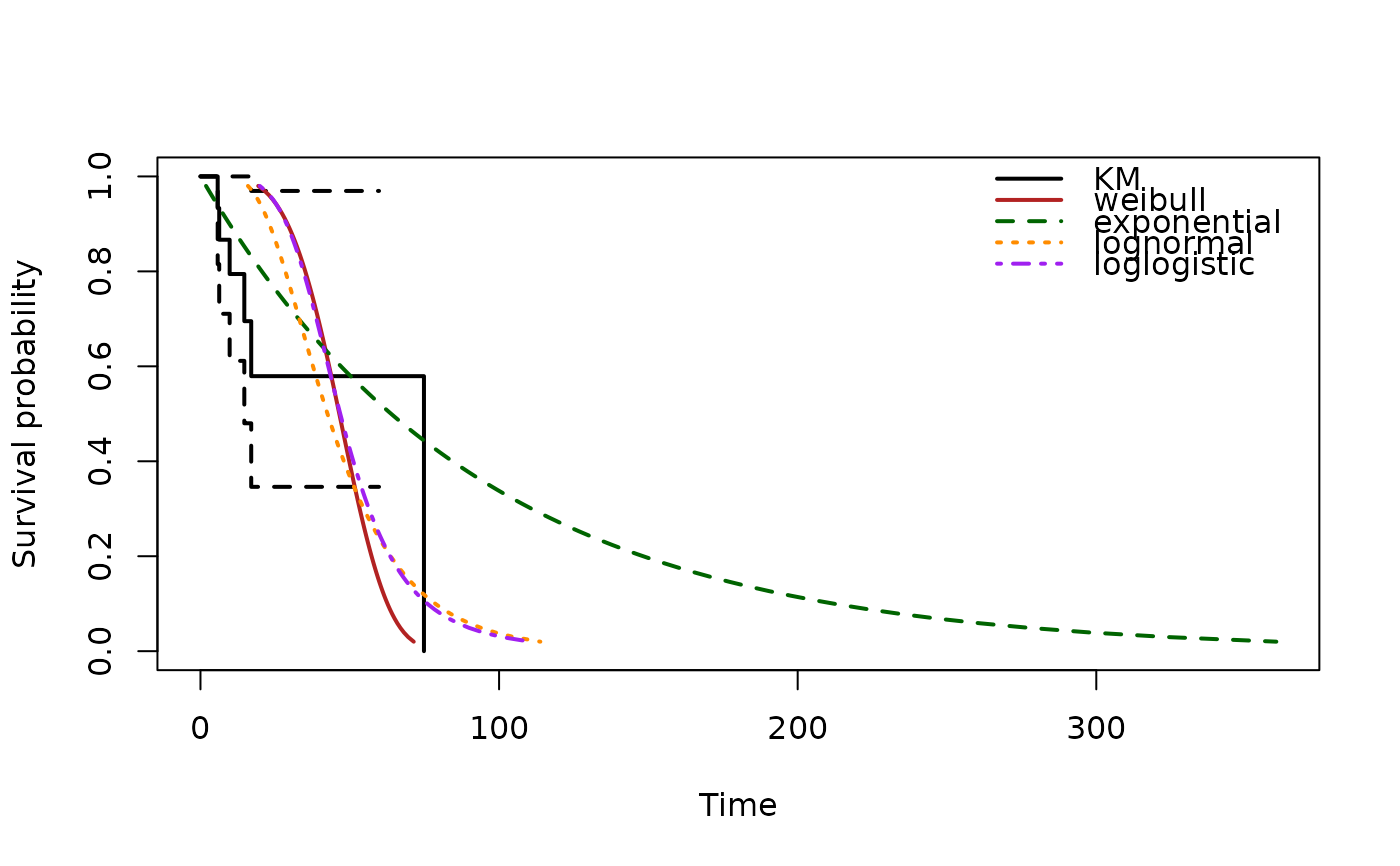
estimate, and a plot() method that draws the KM curve together with
the parametric curves.
survival_parametric(
  sig,
  se,
  dists = c("weibull", "exponential", "lognormal", "loglogistic")
)
Arguments
- sig
An object of class
"rnaSentry_signature"as returned bybuild_signature.- se
A
SummarizedExperimentcontaining the signature genes in its rows and the survival metadata columns recorded insig(sig$time_colandsig$event_col). Expression is taken from the same analysis assay used at signature-build time (seebuild_signature).- dists
Character vector of parametric distributions to fit, any subset of
"weibull","exponential","lognormal"and"loglogistic". Defaults to all four.
Value
An object of class "rnaSentry_parametric" (a list) with
elements:
- genes
The signature genes scored.
- score
Per-sample risk score (linear predictor).
- fits
Named list of
survregfits, one per distribution.- table
Data.frame comparing distributions on
loglik,npar,AIC,delta_AIC,weightandbest, ordered by increasing AIC.- best
Name of the lowest-AIC distribution.
- km_fit
The
survfitobject of the whole cohort.- curves
Named list of fitted survival curves (data.frame with
timeandsurvival), evaluated at the mean risk score.- sig_locked
Whether the input signature was locked.
- created
Provenance timestamp.
- flags
Data.frame of issues raised (e.g. a model that failed to fit, or near-tied AIC values), with columns
check,severity,detailandstage.
Details
The stage is read-only: it works on both locked and unlocked signatures and records the signature's lock state in its output.
Examples
library(SummarizedExperiment)
set.seed(9)
counts <- matrix(rpois(450, lambda = 500), nrow = 30, ncol = 15,
                 dimnames = list(paste0("gene", 1:30), paste0("S", 1:15)))
sig_expr <- colMeans(counts[1:4, , drop = FALSE])
risk <- scale(sig_expr)[, 1] * 0.4
event_time <- rexp(15, rate = 0.03 * exp(0.8 * risk))
censor_time <- rexp(15, rate = 0.02)
time <- pmin(event_time, censor_time)
event <- as.integer(event_time < censor_time)
coldata <- S4Vectors::DataFrame(time = time, event = event,
                                 row.names = colnames(counts))
se <- SummarizedExperiment(assays = list(counts = counts), colData = coldata)
sig <- build_signature(se, "time", "event", top_n = 4, repeats = 1,
                       folds = 2, seed = 1)
#> Warning: Only 6 event(s) for a 3-gene signature (2.0 events per parameter), below 'min_events_per_parameter' = 5. Cross-validated concordance and hazard ratios are unstable at this event count; consider fewer genes or a larger cohort.
sp <- survival_parametric(sig, se)
sp
#> rnaSentry parametric models: 3-gene signature, 15 samples.
#> AIC comparison:
#>   weibull      AIC    44.18  delta   0.00  weight 0.733 *
#>   loglogistic  AIC    46.96  delta   2.79  weight 0.182
#>   lognormal    AIC    48.70  delta   4.53  weight 0.076
#>   exponential  AIC    53.06  delta   8.89  weight 0.009
#> Best model: weibull.
#> Signature not locked.
plot(sp)